
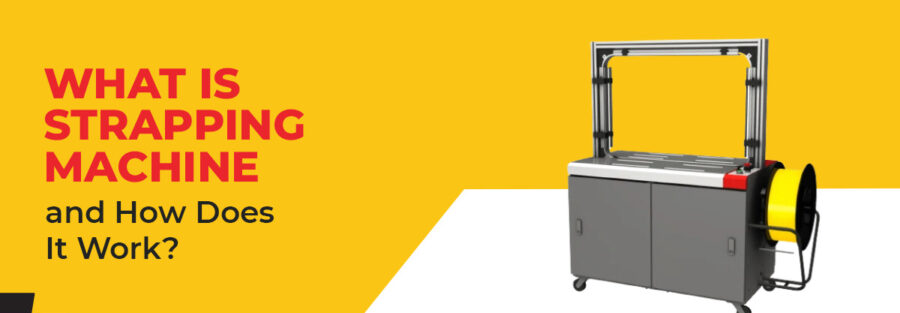
Short Summary
A strapping machine is a packaging machine that wraps a strap around cartons, bundles, pallets, or products, then tensions, seals, and cuts it, automatically or semi-automatically, to secure goods for transport and storage. This blog covers the answer to “What is a strapping machine?” & strapping machine meaning, how it works step-by-step, its core components, sealing methods, types (manual, semi-automatic, and fully automatic), strap materials, industry applications, and market data on why strapping matters more than ever.
Introduction: Why Secure Packaging Matters Before Products Leave the Factory
In manufacturing and logistics, packaging is much more than placing products in a box. Products travel through multiple stages before reaching customers: warehousing, loading, transportation, unloading, and final delivery. At every stage, movement, vibration, stacking pressure, and handling risks act on the load.
Without proper load securing, cartons can open, products can shift, and pallets can become unstable — leading to costly damage and customer complaints. Industry data backs this up: nearly 1 in 25 shipments in the U.S. arrives with some form of damage, and much of that traces back to inadequate securing at the packaging stage, not the carrier.
This is where strapping machines become essential. Understanding what a strapping machine is and how it works can help manufacturers improve packaging efficiency, reduce labour costs, and ensure products arrive safely at their destination — whether you’re packaging lightweight cartons or heavy industrial loads.
What Is a Strapping Machine?
A strapping machine is a packaging machine that wraps a strap around cartons, bundles, pallets, or products, then tensions, seals, and cuts it automatically or semi-automatically. Its purpose is to secure goods during transportation, prevent cartons from opening, stabilise pallet loads, reduce shipping damage, and speed up packaging operations.
Depending on the application, strapping machines use polypropylene (PP), polyester (PET), or steel strap, applying the tension level appropriate for the load. This is the core strapping machine definition worth remembering: it’s not just a “banding tool” — it’s a controlled tension-and-seal system built for repeatable load containment.
Strapping Machine vs Strapping Tool: What’s the Difference?
| Feature | Strapping Machine | Strapping Tool |
| Definition | A stationary or semi-stationary packaging system that automatically feeds, tensions, seals, and cuts the strap in one complete cycle. | A manual, handheld, or battery-operated device used to tension and seal straps around products or pallets. |
| Operation | Semi-automatic or fully automatic with a foot pedal, push button, or automatic trigger. | Operated manually by the user around the load. |
| Automation Level | High – performs feeding, tensioning, sealing, and cutting automatically. | Low – requires manual positioning and operation. |
| Portability | Fixed installation; designed for packaging stations or production lines. | Lightweight and portable; can be used anywhere in the warehouse or loading area. |
| Packaging Volume | Ideal for medium to high-volume packaging operations. | Best suited for low-volume or occasional strapping tasks. |
| Best Applications | Production lines, warehouses, logistics centres, and repetitive packaging operations. | Pallets, oversized loads, irregular-shaped products, and mobile packaging jobs. |
| Consistency | Delivers uniform strap tension and sealing for every package. | Depends on operator skill and may vary between applications. |
| Productivity | High throughput with faster packaging cycles. | Slower packaging speed due to manual operation. |
| Initial Investment | Higher upfront investment but greater long-term productivity and ROI. | Lower initial cost, making it suitable for smaller operations. |
| Ideal Choice | Businesses requiring consistent, repeatable, and high-speed packaging. | Businesses needing flexibility, portability, and occasional strapping tasks. |
What Does a Strapping Machine Do? (The Purpose of Strapping)
Strapping, as a process, achieves three things: securing individual packages, bundling multiple items together, and unitising loads on a pallet so they move and store as one stable unit. Before automated systems, businesses relied on manual strapping, which was slow, inconsistent, and labour-intensive.
Modern strapping machines solve this with the following:
- Faster packaging cycles
- Consistent strap tension across every pack
- Improved product protection
- Lower labour costs
- Reduced packaging waste
For businesses focused on operational efficiency, a strapping machine is no longer optional — it’s a core part of the packaging line. This isn’t a marginal trend either: the global strapping machine market was valued at roughly USD 5.78 billion in 2025 and is projected to reach USD 9.36 billion by 2034, growing at a steady CAGR.
Key Components of a Strapping Machine
To understand how a strapping machine works, it helps to know its major parts:
1. Strap Roll
The strap roll contains the packaging strap that secures the load.
2. Strap Feeding Mechanism
This system feeds the strap around the product automatically.
The feeding mechanism ensures the following:
- Proper strap placement
- Smooth operation
- Consistent cycle times
3. Tensioning Unit
The tensioning method pulls the strap tighter around the container.
Proper tension is crucial because:
- Excessive tension may damage cartons
- Insufficient tension may result in unstable loads
4. Sealing Unit
The sealing unit joins both ends of the strap together.
Common sealing methods include:
- Heat sealing
- Friction welding
- Metal seals
A strong seal ensures the strap remains intact throughout transportation.
5. Cutter
After sealing, the machine cuts the excess strap automatically.
This creates a clean and professional finish while reducing material waste.
6. Control Panel
The control panel allows operators to adjust the following:
- Tension settings
- Cycle speed
- Strap feed length
- Operating modes
Modern machines often have digital interfaces to facilitate operation.
How Does a Strapping Machine Work? Step-by-Step
Machine designs vary, but most strapping machines follow the same basic cycle:
Step 1: Product Placement
The carton, bundle, or pallet is positioned in the strapping area.
For automatic machines, conveyors often move products into place.
Step 2: Strap Feeding
The machine feeds the strap around the package through a guide path or arch.
The strap completely surrounds the load before returning to the sealing mechanism.
Step 3: Tension Application
The machine pulls the strap tightly around the product.
The tension setting depends on:
- Product weight
- Carton strength
- Strap type
- Transportation requirements
This step ensures the load remains secure during handling.
Step 4: Sealing
Once the desired tension is achieved, the machine seals the strap.
The seal creates a strong connection between both ends of the strap.
This prevents the strap from loosening during transit.
Step 5: Cutting
The machine automatically cuts the remaining strap after sealing.
This completes the packaging cycle.
Step 6: Package Removal
The strapped package is ready for:
- Storage
- Palletizing
- Shipping
- Distribution
The entire process often takes only a few seconds.
On a semi-automatic machine, the operator triggers this cycle (often via a foot pedal) after manually positioning the strap; on a fully automatic strapping machine, the entire sequence runs with minimal human input. The whole cycle typically takes just a few seconds.
Sealing Methods Explained: Heat Seal vs Friction Weld vs Buckle Seal
The seal is what keeps a strap from loosening mid-transit, and different machines use different joining methods:
| Sealing Method | How It Works | Common Applications | Key Advantage |
| Heat Seal | Melts the overlapping strap ends together using controlled heat to create a secure bond. | Commonly used on strapping machines running PP (Polypropylene) or PET (Polyester) straps. | Produces a strong and consistent seal when the temperature and dwell time are correctly set. |
| Friction Weld | Generates heat through rapid friction between the strap ends instead of using an external heat source, fusing them together. | Widely used in portable, battery-operated, and handheld strapping tools. | Provides a reliable seal without external heating, making it ideal for mobile applications. |
| Buckle / Metal Seal | Uses a metal buckle or clip that is crimped over the strap ends to lock them securely in place. | Typically used with steel straps for heavy-duty industrial applications and extremely heavy loads. | Offers maximum holding strength for applications where heat- or friction-based sealing methods are not suitable. |
Choosing the right method isn’t just a machine preference; it’s tied to strap material, load weight, and how much weld strength the shipment actually needs.
Types of Strapping Machines
Different industries need different levels of automation, so strapping equipment spans a range of configurations:
| Type of Strapping Machine | How It Works | Key Features | Best For |
| Semi-Automatic Strapping Machine | The operator manually inserts the strap into the machine, which then automatically tensions, seals, and cuts it. | It requires minimal operator effort, is easy to operate, and is suitable for moderate packaging needs. | This machine is ideal for small manufacturers, warehouses, and medium-volume packaging operations. |
| Fully Automatic Strapping Machine | The fully automatic strapping machine is integrated directly into production lines, where products move automatically via conveyors and the machine performs the complete strapping cycle without manual intervention. | Fully automated operation, high-speed packaging, consistent strap application, and seamless production line integration. | Large-scale manufacturing facilities, distribution centres, and continuous high-volume production environments. |
Types of Strap: PP, PET, and Steel
The strap material determines how much load a strapping machine can secure:
- Polypropylene (PP) strap — Lightweight, cost-effective, and ideal for cartons and light-to-medium packages.
- Polyester (PET) strap — Stronger and more tension-retentive than PP, suited to heavier loads and palletised shipments over long transit distances.
- Steel strap — Maximum strength, used for heavy industrial applications such as coils, lumber, and construction materials where poly strapping can’t hold.
Where Are Strapping Machines Used? Common Industries and Applications
Strapping machines show up wherever product security and packaging efficiency are non-negotiable:
- Manufacturing: Bundling components and finished goods for dispatch
- Food & beverage: Securing cartons and case packs for cold-chain and retail distribution
- E-commerce: High-volume carton strapping for fast, damage-free fulfilment
- Pharmaceuticals: Tamper-evident, consistent sealing for regulated shipments
- Logistics & warehousing: Pallet strapping for stable, stackable unit loads
- Automotive: Bundling parts and components for line-side delivery
- Printing, bricks/tiles, and agriculture: Bundling newspapers, construction materials, and agricultural produce for transport
Strapping vs Other Packaging Methods
Strapping isn’t the only way to secure a load, and it isn’t always the right one. Stretch wrap is better suited to containing loose or irregular pallet loads against dust and moisture, while tape works for sealing carton flaps on lighter cartons. Strapping earns its place when the priority is load containment under tension, keeping a bundle from separating or a stacked pallet from shifting rather than just covering or closing a package.
In many operations, strapping and stretch wrapping are used together: stretch film for containment and strapping for structural rigidity.
Common Problems and How to Avoid Them
Even a well-built strapping machine will underperform if you use it incorrectly. The most frequent issues are incorrect strap selection, excessive tension, poor maintenance, weak seals, and operator error, all of which are preventable with proper training and a regular inspection routine. Preventive maintenance and clear operating procedures eliminate the majority of downtime-causing problems before they start.
The Durapak Advantage: Smarter Packaging for Higher Productivity
A strapping machine is only as effective as the solution behind it. At Durapak, we help manufacturers improve packaging efficiency with reliable strapping systems designed for speed, consistency, and long-term performance, whether you’re securing cartons, bundles, or palletised loads.
Our strapping machines deliver precise tensioning and strong seals that reduce product damage during storage and transportation. Paired with the right strapping consumables and expert guidance, we help manufacturers optimise end-of-line operations, reduce packaging costs, and improve overall productivity.
Conclusion
Understanding what a strapping machine is and how it works is essential for any business looking to improve packaging efficiency and reduce logistics costs. A strapping machine is far more than a packaging tool, it’s a productivity-enhancing system that secures products, speeds up operations, reduces labour dependency, and protects goods throughout the supply chain.
Whether you operate a small warehouse or a large manufacturing facility, choosing the right strapping machine can significantly improve packaging consistency and load stability. As packaging demands continue to grow, investing in reliable strapping equipment is one of the smartest ways to improve operational performance, reduce waste, and ensure products reach customers safely.
Frequently Asked Questions
1. What is a strapping machine?
A strapping machine is a packaging machine used to secure cartons, bundles, pallets, and products with plastic or steel straps. It tensions, seals, and cuts the strap to keep goods stable during storage, handling, and transportation.
2. How does a strapping machine work?
It works by feeding a strap around the package, tightening it to the required tension, sealing both ends together, and cutting the excess strap. This creates a secure pack ready for storage or shipping.
3. What is a strapping machine used for?
Strapping machines secure cartons, pallet loads, bundles, boxes, newspapers, pipes, and tiles. They’re widely used in manufacturing, logistics, warehousing, e-commerce, food, pharma, and automotive industries.
4. What are the main types of strapping machines?
The main types are semi-automatic strapping machines and fully automatic strapping machines. Semi-automatic machines need operator support, while fully automatic ones work with conveyors for high-volume lines.
5. Which strap material is best for strapping machines?
It depends on the application: PP strap suits lightweight cartons, PET strap suits heavier loads, and steel strap is used for heavy-duty industrial packaging needing maximum strength.
6. What’s the difference between a strapping machine and a strapping tool?
A strapping tool is usually a manual or battery-powered handheld device for mobile, low-volume jobs. A strapping machine is a semi-automatic or fully automatic system built for repeatable, higher-volume packaging lines.
7. What are the most common strapping machine problems?
Common strapping machine problems include incorrect strap selection, excessive tension, weak seals, poor maintenance, and operator error. Most of these issues can be prevented through proper training, routine inspections, and clear operating procedures.
8. What’s the difference between semi-automatic and fully automatic strapping machines?
A semi-automatic machine requires the operator to insert the strap manually before it tensions, seals, and cuts. A fully automatic machine feeds, tensions, seals, and cuts the strap on its own, suited to faster, continuous packaging operations.
9. How do I choose the right strapping machine?
Base your choice on product weight, package size, production volume, strap material, required tension level, and whether you need manual, semi-automatic, or fully automatic operation.
10. Why should businesses invest in a strapping machine?
It reduces manual packaging effort, speeds up dispatch, prevents transit damage, and improves overall logistics efficiency, a cost-effective way to secure products and boost productivity.